1.Our Commitment to achieving Net Zero Carbon
MacConvilles Ltd. (MacConvilles) is committed to achieving Net Zero Carbon emissions by 2030 (Scope 1, 2 and selected Scope 3). This target demonstrates our ambition to reducing our environmental impact in support of the UK Government’s Net Zero Targets.
This target demonstrates our ambition to become industry leaders in reducing our environmental impact in support of the UK’s Net Zero Target. This requires MacConvilles to reduce our operational GHG emissions as close to zero as possible by 2030 and then using carbon offsetting/sequestration to mitigate our remaining operational emissions (residual emissions from essential business operations).
This report outlines our baseline and current GHG emissions, our interim targets and reduction trajectory, as well as our completed and planned reduction projects.
2. GHG Emissions Footprint FY 2018 – 2025
2.1 Organisational and Operational Boundaries
According to the GHG Protocol Standard, the organisational boundary defines the businesses and operations that constitute the company for the purpose of accounting and reporting GHG emissions. Companies can choose to report either the emissions from operations over which they have financial or operational control (the control approach) or from operations according to their share of equity in the operation (the equity share approach).
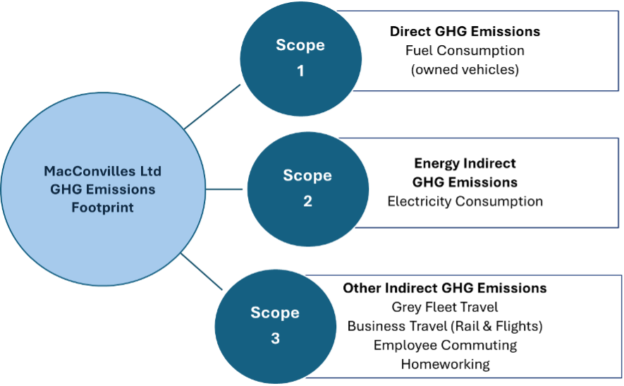
MacConvilles has accounted for all quantified GHG emissions over which it has operational control. Indirect GHG sources that are outside of the assessment boundary have been excluded from the assessment as it is not technically feasible or cost effective, to include these in the GHG assessment (waste and Upstream/Downstream transportation and distribution are excluded but should this change in the future MacConvilles will add them in to comply with requirements of PPN 006). The emission sources included in the operational boundary of the carbon footprint assessment are summarised in Figure 1 below.
Figure 1 -Summary of applicable emission sources
2.2 Reported Baseline and Latest GHG Emissions
MacConvilles Limited’s baseline year and latest year greenhouse gas (GHG) emissions footprint for FY 2018/19 and 2024/25 (1st November – 31st October) are presented below. The 2018/19 results will be used as a benchmark against which future targets and our progress towards Net Zero will be measured against.
GHG emissions have been calculated following best practice methodology set out by the GHG Protocol and UK Government Reporting Guidelines. Scope 1, Scope 2 and Scope 3 GHG emissions have been calculated following recognised best practice set out by the GHG Protocol. All results are presented in tonnes CO2e (carbon dioxide equivalent).
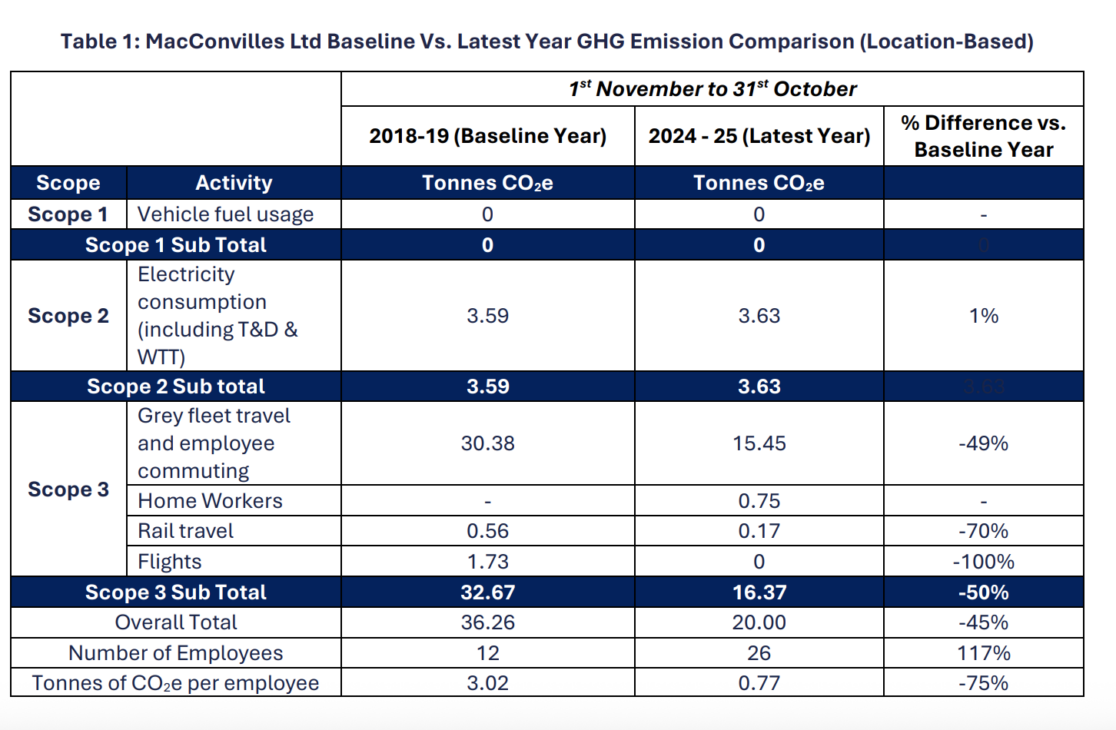
Figure 2: MacConvilles Ltd Base Year and Latest Year GHG Emissions Split by Source 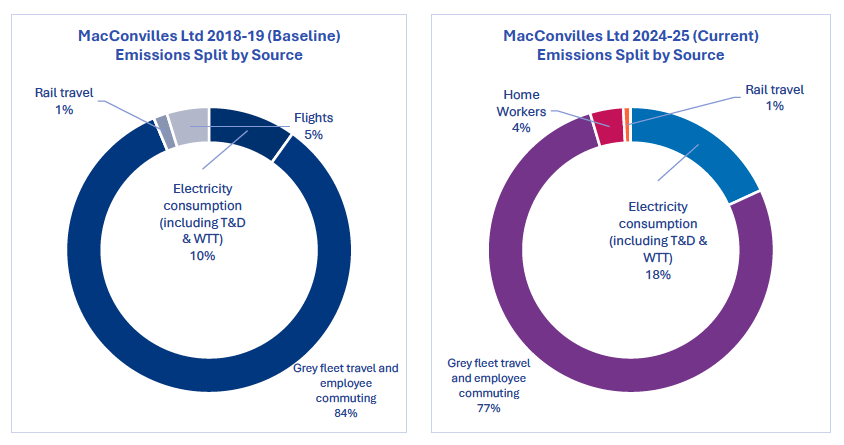
3. Emissions Reduction Targets & Trajectories
MacConvilles is committed to become Net Zero by 2030 across our Scope 1, 2 and selected Scope 3 as mentioned above. This means that we will aim to reduce our Scope 1, 2 and selected Scope 3 emissions by 90% by 2030 and will mitigate our residual GHG emissions (i.e., emissions we are unable to reduce any further, those from the essential operations of the company) through carbon offsetting and/or sequestration mechanisms to achieve Net Zero Carbon.
The trajectory outlined below presents a reduction pathway that illustrates that by 2030, we project our emissions to decrease to 3.63 tCO2e. This is a reduction of 90%.
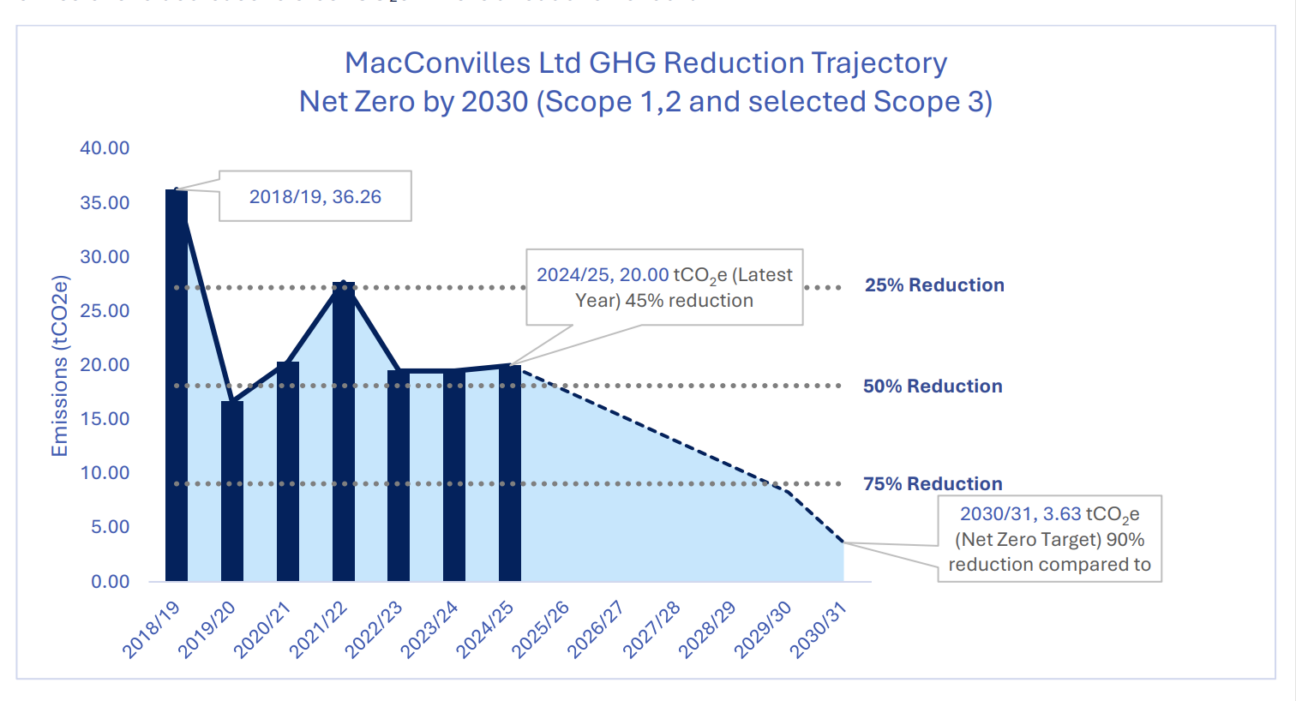 Figure 3: MacConvilles Ltd. GHG Emissions Trajectory
Shading denotes the gap between trajectory and zero GHG emissions and is used to provide an indication as to the magnitude of offsetting/sequestration required to achieve Net Zero. This chart will be updated on an annual basis to show our progress against this reduction trajectory (dotted line).
MacConvilles is committed to updating our Carbon Reduction Plan and our trajectory chart annually. This will support communication of our progress towards Net Zero and allow us to identify additional actions needed to meet our Net Zero target year.
4. Carbon Reduction Projects
MacConvilles Limited already operate in a manner that helps minimise costs & their impact on the environment. The progress and impact of the measures already in place is actively monitored by our Project Managers.
It is to be noted that MacConvilles operate out of serviced offices which are managed by landlords. Hence, at the moment, there are limited opportunities for us to reduce emissions from our electricity consumption (Scope 2). We however, plan to continue to liaise with our landlords to switch to a 100% renewable electricity tariff and ensure that our office is operated in an energy efficient manner. We have also been fully offsetting our emissions annually and so are a Carbon Neutral + organisation since 2018/2019, working with our partner Carbon Footprint.
Although we cannot do much to directly reduce our grey fleet emissions, we will ensure to plan routes efficiently and look for opportunities to reduce unnecessary business travel. We also have a cycling & EV scheme in place encouraging our staff to prioritise active and low-carbon commuting options wherever possible.
5. Declaration & Sign Off
This Carbon Reduction Plan has been completed in accordance with PPN 006 and associated guidance and reporting standards for Carbon Reduction Plans.
GHG emissions have been reported and recorded in accordance with the published reporting standard for Carbon Reduction Plans and the GHG Reporting Protocol Corporate Standard; using the appropriate Government emission Conversion Factors for GHG Company Reporting.
Scope 1 and Scope 2 emissions have been reported in accordance with SECR requirements, and the subset of Scope 3 emissions have been reported in accordance with the published reporting standard from Carbon Reduction Plans and the Corporate Value Chain (Scope 3) Standard.
This Carbon Reduction Plan has been reviewed and signed off by the board of directors (or equivalent management body)
 T A Rollestone
  B Coombs


