Punching Shear in Transfer Slabs: Essential Guidance for Facility Managers
22nd January 2026
Punching Shear in Transfer Slabs: What Facility Managers Need to Know Right Now
The UK’s Building Safety Regulator (BSR) has issued a new statement highlighting concerns around punching shear in reinforced concrete transfer slabs — a structural failure mechanism that, in extreme cases, can lead to partial building collapse.
While the government stresses that no such collapses have been recorded in the UK, the alert signals a clear shift: Building Owners and Facility Managers must take proactive steps to understand and manage this emerging risk.
In a post‑Grenfell regulatory environment, this is not just a structural engineering issue. It’s a building safety, compliance, and operational continuity issue — and Facility Managers sit at the centre of it.
What is punching shear — and why does it matter?
Punching shear occurs when a concentrated load causes a column to “punch” through a slab and can occur in any concrete slab. Transfer slabs — thicker concrete slabs used to redistribute loads between different column layouts — are particularly vulnerable due to the more complex load paths. More detailed design guidance for the design of transfer slabs is now available from the Institute of Structural Engineers with some concern about the way which older buildings were designed.
For Facility Managers, this matters because:
Transfer slabs may be hidden behind the building’s finishes making assessment difficult, however early identification can prevent escalation, disruption, and costly remediation
What the BSR is advising
The BSR’s guidance is clear: Where there are visible signs of distress or specific concerns about a building’s condition or design, building owners should seek immediate professional advice. This is not about causing alarm — it’s about ensuring that FM teams have the right information, processes, and professional support.
RICS has reinforced this by recommending that: Chartered Building Surveyors may be instructed to carry out survey to identify whether transfer slabs are present and any associated defects.
If identified, a competent structural engineer — ideally via IStructE — should undertake detailed analysis. This creates a clear pathway for Facility Managers to follow.
What Facility Managers should do now
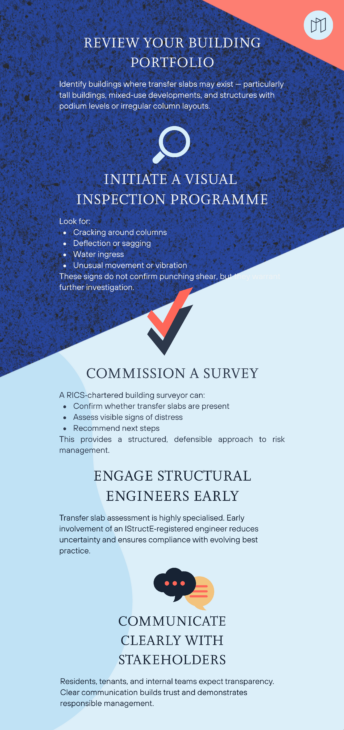
1. Review your building portfolio
Identify buildings where transfer slabs may exist — particularly tall buildings, mixed‑use developments, and structures with podium levels or irregular column layouts and re-purposed buildings.
2. Initiate a visual inspection programme
Look for:
- Cracking around columns
- Deflection or sagging
- Water ingress
- Unusual movement or vibration
These signs do not confirm punching shear, but they warrant further investigation.
3. Commission a survey
A RICS‑chartered Building Surveyor can:
- Confirm whether transfer slabs are present
- Assess visible signs of distress
- Recommend next steps
This provides a structured, defensible approach to risk management.
4. Engage structural engineers early
Transfer slab assessment is highly specialised. Early involvement of an IStructE‑registered engineer reduces uncertainty and ensures compliance with evolving best practice.
5. Communicate clearly with stakeholders
Residents, tenants, and internal teams expect transparency. Clear communication builds trust and demonstrates responsible management.
Why this matters for Facility Management teams
Facility Managers are increasingly accountable under the Building Safety Act. This issue reinforces the need for:
- Proactive structural risk management
- Robust documentation and audit trails
- Competent professional engagement
- Early intervention to avoid operational disruption
In short: this is an opportunity for FM teams to demonstrate leadership in building safety.
Final thought
Punching shear in transfer slabs is not a widespread failure mechanism — but it is a credible risk that the BSR is taking seriously. Facility Managers who act early, engage the right professionals, and document their decisions will be best placed to protect their buildings, their organisations, and the people who use them.
If you’d like support with surveys, building safety assessments, or structural risk pathways, our team is here to help.
About the Author
Tim Pye BEng (Hons) CEng MIStructE is an experienced Senior Building Surveyor with a background in structural engineering, including becoming a Chartered Member of the Institution of Structural Engineers in 2007. Although no longer practising as a Structural Engineer, his combined expertise provides a rare dual‑discipline perspective on the design, construction, and management of buildings. This blend of experience places them in an ideal position to comment on emerging building‑safety issues, including the identification and understanding of transfer slabs.
Related posts
Building Safety Levy 2026: What UK Developers Need to Know Before the October Deadline Read More
Approved Document B Is Evolving: What It Means for Existing Buildings
A practical view of Approved Document B changes and their impact on existing buildings.
Read More


